

Oral hygiene
Tips and products for better oral hygiene. The road to healthy teeth starts in the dental surgery and continues at home.
Daily brushing and flossing are the basis of good oral care. Their purpose is to break up and remove plaque – a bacterial film that discolours the teeth and builds up on them, between them and under the gums.
Plaque is one of the main causes of tooth decay and gum disease. If it builds up, it can lead to cavities, bleeding gums, bone destruction and even tooth loss.
How do bacteria damage the teeth and gums?
The bacteria in plaque produce acid that eats away the enamel – the hard protective coating of the teeth – and so cavities form. Plaque also irritates the gums; the early form of gum disease is called gingivitis.
Plaque is easy to control with three simple steps:
- Brush your teeth at least twice a day. Use a soft-bristled brush that fits comfortably in your mouth and reaches everywhere, and a fluoride toothpaste, which helps stop tooth decay.
- Clean the spaces between your teeth. If you do not floss, you leave more than 40 % of the surface of your teeth uncleaned.
- Visit the dentist and the hygienist at least twice a year – for a professional clean and a check-up.
Brushing correctly
It takes about two minutes. An example of effective brushing:
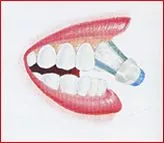
1. For the outer surfaces of the teeth, place the brush at a 45° angle to the gum line.
2. Move it back and forth over the teeth and gums with gentle, short strokes.
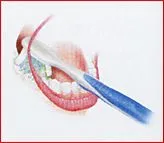
3. Use the same movement to clean the chewing and inner surfaces.
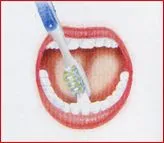
4. For the inside of the front teeth, hold the brush upright and clean with its tip using up-and-down strokes.
5. Also brush along the gum line and reach the back of the last teeth.
6. Clean your tongue too – that way your breath will stay fresh!
Change your toothbrush
Change your toothbrush when it starts to wear out, or every three months. Studies show that a new brush removes 30 % more plaque than a brush that has been used for three months.
What about electric toothbrushes?
Their modern design combines technologies for removing plaque effectively and makes them reliable and safe. Clinical studies show that electric toothbrushes (and Oral-B ones in particular) remove noticeably more plaque than a manual brush.
How to use an electric toothbrush
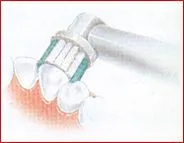
1. Move the brush head gently from tooth to tooth, following the curve of the gums and the shape of each tooth.
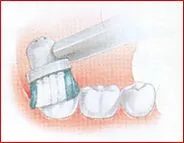
2. Hold the brush in place for a few seconds before moving it to the next tooth.
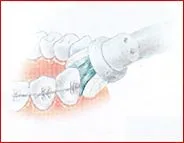
3. Reach every surface of the teeth – front, back and chewing.
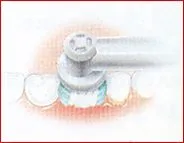
4. Brush the gums and the teeth. Do not press or scrub hard – let the brush do the work.
Flossing
It is just as important as brushing. Once you have brushed the front, back and chewing surfaces of your teeth, you also need to get between them – where the brush cannot reach.
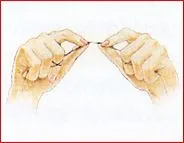
1. Take about 40 cm of floss and wind it loosely around the middle fingers of both hands – first around one, then around the other, leaving 2–3 cm between them.
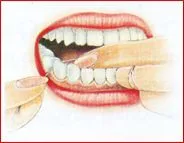
2. Hold the floss taut with your thumbs and index fingers and guide it gently between the teeth, without pressing it hard against the gum.
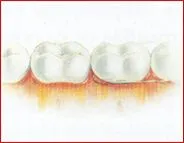
3. Curve the floss around the tooth in a “C” shape and move it gently up and down along the sides of the tooth and under the gum. For each next tooth, unwind a fresh section of floss.
Do not worry if your gums bleed the first time – this is common and may be a sign of gum disease. After a few days of flossing the bleeding stops, because the gums become healthier. If it continues, consult your dentist or hygienist.
Got children? Start early!
Healthy teeth are the key to a healthy childhood: children need them to chew, for digestion, to speak clearly and to look good. Thanks to advances in dentistry and in care products, children today are growing up with healthy, cavity-free teeth more than ever before. Here is how to start:
- Even before they have teeth, children’s gums should be cleaned – with gauze or a damp piece of cloth after feeding and before bed.
- Do not put your child to sleep with a bottle of milk.
- Ask the dentist about additional fluoride treatments.
- Brush your child’s teeth until the age of three, and then encourage them to do it themselves.
- Children under four should brush with a simple technique – small circular movements with the brush.
- Encourage the habit of brushing at least twice a day (after breakfast and before bed) with a children’s fluoride toothpaste. When you brush your teeth together, you set a good example – children learn by imitating you, and brushing becomes fun.
- Supervise brushing until the age of eight.
- You could also consider an electric toothbrush for your child – it has been clinically proven to be as gentle and safe as a manual one.
- Do not use much toothpaste – a pea-sized amount is enough. The child should spit out the toothpaste and rinse the mouth with water, not swallow it.
- When your child’s teeth close up (between two and six years of age), help them get used to flossing every day.
- Plan a visit to the dentist or hygienist at least once every six months.
And most important of all – praise your child for a job well done.
Children’s teeth by age
- The first teeth (the four front ones) usually appear between six months and one year.
- The first visit to the dentist is between the appearance of the first tooth and the first birthday.
- By the age of three a child should have all 20 baby teeth. Around this age they learn to brush their teeth themselves with small circular movements, and you go over them afterwards to make sure the teeth and gums are completely clean.
- The baby teeth are replaced by permanent ones from the age of 6 to 12 or 13 – by then the child has 28 or 32 permanent teeth. The wisdom teeth come through last, at around the age of 16.
- Supervise brushing until the age of eight and floss your child’s teeth until they learn to do it themselves – at around the age of 10.
- Anyone over the age of six can rinse with fluoride. With regular use, rinsing at home reduces decay noticeably – by up to 40 % more than brushing alone.
Eat well! A well-balanced diet helps the teeth stay healthy for a long time. Choose foods from the five main food groups, be careful with snacks between meals and limit sweets to main mealtimes.
See also prevention for adults and children.
Book an appointment
We work by appointment. If you cannot come, please let us know in good time so that we can give the slot to another patient.